
How Long Does Tree Removal Take? A Complete Homeowner Timeline
- Out on a Limb Tree Experts

- May 21
- 8 min read
Managing your property means keeping an eye on the safety, health, and beauty of your landscape. When a tree becomes diseased, structurally unsound, or dangerously close to utility lines, extraction becomes necessary. But how long does tree removal take, and what should you expect during the process? For most standard residential properties, the physical extraction process takes anywhere from 1.5 to 4 hours. However, the total project timeline-from your initial phone call to final site cleanup-spans a few days to a couple of weeks.
Understanding the factors that influence this timeline helps you plan ahead, prepare your property, and ensure a seamless experience. In this comprehensive guide, we will break down the exact hourly and daily timelines for professional tree extraction, look at the key variables that speed up or slow down the project, and provide a framework to help you prepare.
The Typical Tree Removal Timeline Broken Down

Every property is unique, but professional arborists generally follow a strict, phased protocol to ensure safety and efficiency. To understand how long does tree removal take, it helps to look at the process in two distinct phases: the pre-extraction administrative phase and the active execution day.
Phase 1: Planning and Administrative Preparation (1 to 10 Days)
Before a chainsaw ever starts, several critical logistical steps must occur. Skipping these steps can result in heavy fines, property damage, or severe project delays.
Initial Site Assessment (1–2 Days): A certified arborist must visit your property to evaluate the tree's health, structural integrity, and proximity to hazards. They will provide an accurate quote and outline the required equipment.
Permit Acquisition (2–7 Days): Many municipal zones require formal permits before a mature canopy asset can be cut down. Depending on local government backlogs, obtaining these permissions can take up to a week.
Utility Line Clearance (1–3 Days): If branches are entangled with power or communication lines, local utility companies must be notified to temporarily drop or insulate the lines.
Phase 2: Active Tree Removal Day (1 to 6 Hours)
Once the crew arrives on-site, the active extraction is highly coordinated. The process is broken down hour-by-hour to maximize efficiency and minimize disruptions to your day.
[0:00 - 0:30] Crew Arrival, Safety Briefing, & Equipment Rigging
│
[0:30 - 2:30] Active Tree Felling or Segmented Sectional Cutting
│
[2:30 - 3:30] Debris Chipping, Log Sectioning, & Haul-Away Preparation
│
[3:30 - 4:30] Stump Grinding (Optional) & Final Raking/Site Cleanup
Critical Factors That Influence How Long Tree Removal Takes

No two extractions are identical. While a small ornamental tree might disappear in under an hour, a century-old oak requires meticulous rigging and a much longer time investment. When calculating how long does tree removal take for your specific property, arborists evaluate five primary variables.
1. Tree Size and Height
The physical dimensions of the canopy and trunk are the primary drivers of project duration.
Small Trees (Under 30 feet): Species like dogwoods, Japanese maples, or small fruit trees generally take 45 minutes to 1.5 hours to fully remove.
Medium Trees (30 to 60 feet): Birch, minor pines, or mid-sized maples typically require 1.5 to 3 hours of active cutting and rigging.
Large Trees (Over 60 feet): Massive oaks, mature pines, and weeping willows can easily take 4 to 8 hours, sometimes extending across multiple days if structural decay is advanced.
2. Location and Accessibility
A tree located in a wide-open front yard with direct street access is much easier to manage than one tucked behind a home. If a crew cannot bring heavy machinery like bucket trucks or log loaders close to the trunk, they must use manual climbing techniques.
Manual climbing involves an arborist scaling the trunk using ropes and harnesses, cutting pieces away section by section, and lowering them carefully via advanced rigging systems. This manual maneuvering can easily double or triple the total hours on-site.
3. Proximity to Hazards and Obstacles
Safety dictates the pace of any professional arborist team. If the target trunk stands within striking distance of high-voltage power lines, your home's roofline, a neighbor's fence, or delicate backyard landscaping, the work slows down significantly.
Crew members must carefully tie off every single branch before making a cut, ensuring it drops precisely within a designated landing zone without contacting surrounding assets.
Factor | Fast Extraction Conditions (1-2 Hours) | Complex Extraction Conditions (4+ Hours) |
Tree Species | Softwoods (e.g., Pine, Spruce) | Hardwoods (e.g., Oak, Hickory, Walnut) |
Physical Access | Wide-open yard, direct driveway access | Fenced backyard, narrow gates, steep slopes |
Surrounding Hazards | None; open clearing | Power lines, structures, pools, public roads |
Tree Health Status | Structurally sound, alive | Hollow trunk, dead wood, rotting root system |
Weather Conditions | Clear skies, calm winds, dry ground | High winds, active rain, frozen or muddy turf |
It may seem counterintuitive, but a dead or decaying tree often takes significantly longer to safely remove than a healthy one. Dead wood becomes brittle, unpredictable, and highly prone to sudden snapping under load.
If a trunk is hollow or rotting from fungal disease, it may be too dangerous for an arborist to climb. In these scenarios, specialized cranes must be driven onto the property to hold the tree stable from above while it is systematically dismantled, adding complexity and time to the project.
5. Weather Conditions
Extreme weather conditions pose severe safety risks to tree care crews. High winds, heavy downpours, lightning, and ice accumulation will instantly halt operations. Even dry but muddy conditions caused by recent storms can slow down a project, as crews must lay down specialized ground protection mats to prevent heavy support trucks from tearing up your turf.
Processing and Cleanup: What Happens After the Tree is Down?
The physical felling of the trunk is only half the battle. Once the wood rests on the ground, the intensive process of processing, log hauling, and site remediation begins. This backend work heavily influences the question: how long does tree removal take from start to finish?
Branch Chipping and Material Disposal
As branches are severed from the main trunk, ground crews feed them directly into a commercial wood chipper. This process is remarkably fast but creates substantial noise. Chipping the canopy of a medium-sized specimen generally adds 30 to 60 minutes to the on-site workflow.
Log Sectioning and Hauling
The main trunk cannot fit into a standard chipper. Instead, crews use high-powered chainsaws to slice the trunk into manageable pieces, often referred to as "rounds." If you have chosen to keep the wood for firewood, the crew will stack these rounds neatly on your property. If you want the wood completely removed, loading these heavy trunk sections onto a flatbed or dump truck requires a skid steer or loader, taking an additional 1 to 2 hours.
Unless specified otherwise in your initial service contract, standard tree removal leaves behind a stump cut close to the ground. Complete stump remediation is handled as a separate, optional step.
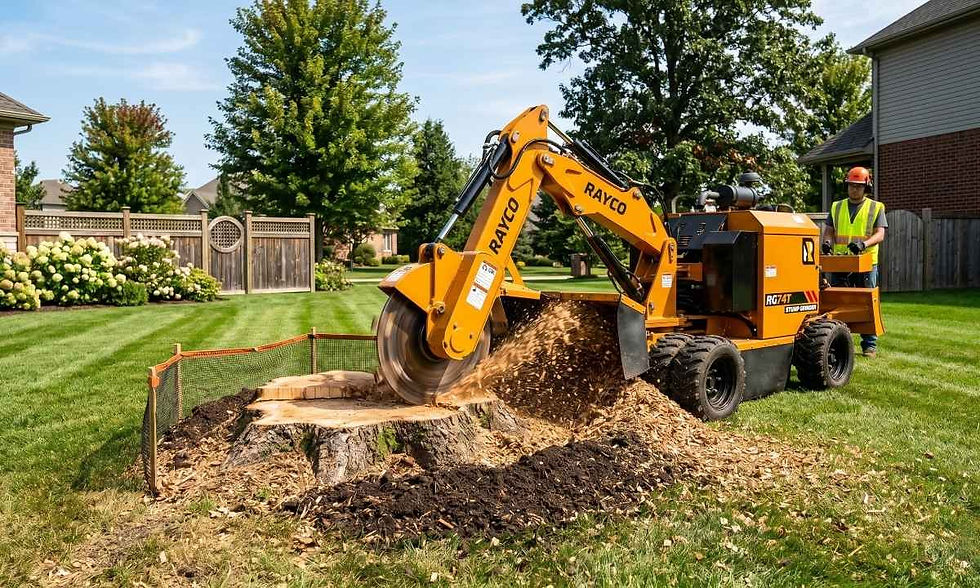
Using a specialized hydraulic stump grinder, a technician shaves the remaining wood down to several inches below the surface soil line. Depending on the diameter of the root base and the hardness of the species, stump grinding adds 30 minutes to 2 hours per unit to your overall project timeline.
[Step 1: Consultation] ──► [Step 2: Permit Check] ──► [Step 3: Yard Prep]
│
[Step 6: Final Cleanup] ◄── [Step 5: Stump Grinding] ◄── [Step 4: Active Cut]
How Property Owners Can Speed Up the Process
While you should always leave the heavy rigging and chainsaw operations to licensed professionals, property owners can take several proactive steps to maximize crew efficiency and shorten the active project timeline.
Clear the Work Zone: Remove patio furniture, potted plants, children's toys, and lawn ornaments from the entire yard before the crew arrives.
Secure Your Pets: Keep dogs and cats safely indoors throughout the entire day. The loud noise of chainsaws and chippers can stress animals, and an escaped pet creates an immediate safety hazard on the worksite.
Coordinate Neighborly Access: If the quickest path to your tree requires crossing a neighbor’s driveway or lawn, get their written permission ahead of time. Informing your neighbors also allows them to relocate their vehicles so streets remain clear for large service trucks.
Provide Clear Parking Spaces: Professional extraction requires substantial street and driveway space. Ensure your driveway is entirely clear of personal vehicles so the crew can position their wood chippers, bucket trucks, and log trailers exactly where they need them.
Signs Your Tree Needs Immediate Extraction
Not all tree care tasks can wait for an extended planning phase. In emergency scenarios, you cannot afford to wait weeks for a convenient opening. Recognizing the signs of an imminent structural failure allows you to call for emergency intervention before disaster strikes.
If you observe a tree leaning suddenly after a major windstorm, notice deep cracks splitting the main trunk, or see large root systems actively lifting out of the soil, your property is in immediate danger. Emergency crews prioritize these structural hazards, bypassing standard scheduling queues to stabilize your environment and protect your home from sudden impacts.
Choosing the Right Team: Out on a Limb Tree Experts
When it comes to altering your home's canopy, choosing an experienced, fully insured provider is essential for protecting your property value and your family's safety. At Out on a Limb Tree Experts, we streamline the entire process to make it as swift, non-invasive, and stress-free as possible.
Our team manages every aspect of your project's timeline, including navigating complex municipal permitting, organizing line clearance details, executing precision cuts, and performing immaculate site cleanups. We pair advanced rigging gear with certified arborist expertise to ensure that even the largest, most dangerously positioned trees are safely managed without unnecessary delays.
Frequently Asked Questions About Tree Removal Timelines
Can a tree be removed in the rain, or will it cause delays?
Light rain or minor drizzle rarely halts an extraction project. However, heavy downpours, lightning storms, or sustained high winds create dangerous climbing and cutting conditions, forcing crews to postpone work for safety. Additionally, extremely saturated, muddy ground can delay a project, as heavy trucks can severely rut and damage wet lawns.
Do I need to be at home while the crew removes my tree?
No, you do not absolutely need to be physically present on your property during the extraction, provided you have granted the crew full yard access, cleared away all outdoor items, and confirmed project details beforehand. However, we highly recommend being reachable by phone just in case our crew encounters unexpected structural issues or needs clarification regarding stump grinding parameters.
How long after the initial tree assessment will the actual removal happen?
On average, active extraction occurs within 5 to 10 business days following your initial site consultation. This buffer allows our team to safely secure mandatory municipal permits, arrange for local utility line spotters, and plan the most efficient equipment deployment for your property's specific needs.
Does stump grinding happen on the exact same day as the removal?
Stump grinding is often scheduled as a separate service step and may occur a few days after the main trunk is taken down. This separation happens because stump grinding requires an entirely different set of heavy, specialized machinery that is towed separately from the primary bucket trucks, chippers, and log loaders used during the initial felling phase.
Will removing a massive tree take more than a single day?
Yes, exceptionally large, structurally compromised, or heavily hazardous specimens can occasionally require 2 to 3 days of meticulous work. When managing a massive canopy asset in tight residential quarters, our crews prioritize controlled precision over speed, utilizing advanced, slow rigging techniques to guarantee absolutely zero damage to your surrounding home, fences, and utility connections.
Maximize the Safety and Efficiency of Your Next Property Project
Delaying the extraction of a dying or structurally unstable specimen only increases the risk of unpredictable property damage and elevated emergency removal costs down the road. By understanding how long does tree removal take, you can plan your week with confidence and protect your investment.
Ready to clear your landscape safely and efficiently? Trust the seasoned professionals at Out on a Limb Tree Experts to handle your project with unmatched care. Contact us today to secure your comprehensive on-site evaluation and personalized property timeline!


Comments